Chuks Okocha, Sunday Aborisade, Onyebuchi Ezigbo, and Folalumi Alaran in Abuja
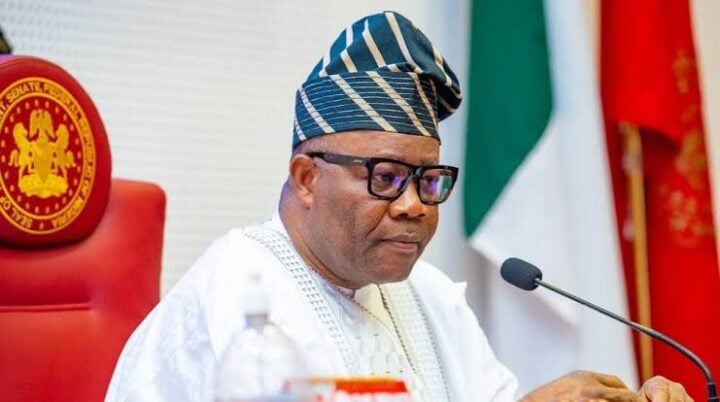
In order to expedite legislative action on the contentious Electoral Act Amendments Bill, Senate President Godswill Akpabio has called an emergency session for tomorrow, Tuesday, February 10, in response to the outcry that followed the recent change to the Electoral Act.
The Senate’s purported rejection of electronic results transmission sparked a backlash from well-known Nigerians. Ambassador Nkoyo Toyo, Comrade Shehu Sanni, Comrade Ene Obi, Professor Pat Utomi, Comrade Ayuba Wabba, Comrade Usman Bugaje, Comrade Bilikisu Magoro, former Senate President David Mark, Mr. Femi Falana, SAN, and Dr. Oby Ezekwesili were among them.
The Nigeria Labour Congress (NLC) also urged the Senate to make sure that the Independent National Electoral Commission (INEC) was given a clear mandate in the updated Electoral Act to electronically transmit and compile polling station results in real-time.
In a statement released yesterday, Senate Clerk Emmanuel Odo instructed all senators to meet again for the emergency session, which is set to start at noon.
It was discovered that the emergency plenary was intended to approve the votes and proceedings of the Senate’s most recent sitting, even though the official notice did not specify the reason for the abrupt recall.
To enable the conference committee on Electoral Act modifications to start working, it is a necessary procedural step.
The development was confirmed by a senior senator who served as a principle officer, who stated that the presiding officer had previously sent a circular to parliamentarians.
“We have been formally asked to reconvene on Tuesday to approve the Votes and Proceedings of our last legislative sitting,” the senator, who spoke on condition of anonymity, stated.
“The conference committee must do this in order to start working on the Electoral Act Amendments Bill.”
Given the growing political tension surrounding restrictions on the electronic transmission of election results, the senator also made a suggestion that the emergency session might start behind closed doors.
Before the day’s primary business, there will probably be an executive session. Serious tension has already been created both inside and outside the National Assembly on the issue of results transmission via electronic means,” he continued.
The abrupt recall occurred in the midst of intensive public scrutiny and growing criticism from election observers, civil society organizations, and opposition parties who said the National Assembly was trying to weaken important measures in preparation for the general election in 2027.
Lawmakers are anticipated to consult with ministries, divisions, and agencies (MDAs) regarding the execution of the 2026 budget during the two weeks that the Senate and House of Representatives are now on recess.
However, the decision to break up the retreat highlights how urgently the leadership of the upper chamber wants to settle any unresolved legislative issues regarding the Electoral Act, the law that will determine the integrity, credibility, and conduct of Nigeria’s future elections.
According to political analysts, Tuesday’s emergency session could be crucial because it could decide the ultimate course of electoral reforms and establish the tone for the upcoming round of talks between the National Assembly, the executive branch, and Nigerian voters, particularly regarding the electronic transmission of election results.
Other Kickers: Mark, Bugaje, Utomi, Falana, Wabba, Ezekwesili, Magori, and Sanni
Ahead of the general election in 2027, prominent Nigerians criticized the Senate yesterday for allegedly rejecting the electronic transmission of results.
Senator David Mark, the National Chairman of the African Democratic Congress (ADC) and a former Senate President, said that the ADC had a clear and uncompromising stance on the issue.
Mark oversaw the public presentation of “The Burden of Legislators in Nigeria,” which took place at the NAF Conference Centre in Abuja.
In his speech, Akpabio emphasized that the Senate has not yet finished working on the Electoral Act modification and encouraged ADC and other opponents of the amendment process to not rush the process.
He claimed that demands for the electronic transmission of election results in real time did not account for Nigeria’s infrastructure issues, pointing out that many rural towns lacked internet connectivity and energy.
He says that permitting such a clause in the legislation may have a detrimental impact on election results.
Mark replied that the senate president was unable to speak for the ADC and that the party’s demand, as well as that of many Nigerians, is simple.
Mark emphasized that ADC only requested that the National Assembly approve the amendment with provisions for real-time results transmission and let the Independent National Electoral Commission (INEC) assess its viability. He said that there was no need for long explanations or justifications.
As neither INEC nor Nigerians are protesting about real-time transmission, Mark stated, “The National Assembly should pass the law and let INEC complain if there is a problem.” Instead, he added, the commission and Nigerians in general were calling for increased election legitimacy and transparency.
He insisted that election laws should be created to preserve the integrity of the vote, not to preemptively restrict it, and claimed that bringing up infrastructure justifications during the legislative stage simply served to erode public trust in the reform process.
The National Assembly’s decision to remove and reject the mandatory electronic transmission of election results in the Electoral Act Amendment Bill 2026 was also rejected by the Movement for Credible Elections (MCE), a recently formed coalition of prominent political activists in Nigeria.
Comrade Ayuba Wabba, Dr. Usman Bugaje, Barrister Femi Falana, SAN, Dr. Oby Ezekwesili, Professor Pat Utomi, Dr. Bilikisu Magoro, Amb Nkoyo Toyo, Comrade Shehu Sanni, Comrade Ene Obi, and Olawale Okunniyi were among the distinguished activists who called the meeting. They decided not to be bound by any political party or politician. They claimed that MCE belonged to Nigerian citizens whose votes had been stolen and manipulated since 1999.
“By this medium, we are calling on our teaming partners and allies not to accept any attempt to roll back the planned Occupy NASS mass protest but to mobilize and proceed peacefully on a mass civic action to defend the popular yearnings of Nigerians in resisting any attempt to return Nigeria to the dark days of manual manipulation and backroom results arising from the distortions occasioned by glitches and interferences with the will of the electorate,” the group said.
They claimed that the parliamentarians’ behavior constituted a clear attack by the National Assembly on Nigerians’ freedom to select their own leaders.
The group claimed that the National Assembly had chosen opacity over transparency, manipulation over credibility, and elite conspiracy over the people’s sovereign choice by rejecting the required broadcast of election results from the polling places and other crucial provisions.
“This is not lawmaking—it is deliberate democratic sabotage against the aspiration of the people of our country as mandatory electronic transmission of results is not controversial,” the group claimed in a statement signed by Comrade James Ezema.
It serves as a bare minimum of protection against ballot rewriting, post-election fraud, and result tampering. Any legislature that opposes it is blatantly supporting a system that depends on rigged elections, stolen mandates, and electoral corruption.
MCE stated it wanted to be clear that the only legitimate reason to oppose obligatory broadcasting was to be afraid of the actual votes and the electorate’s mandate.
“The current situation, wherein results are susceptible to manipulation between polling stations and collation centers, will persist and be abused in 2027,” the organization declared.Apathy will increase if we are unable to provide Nigerians with the transparency they want, which would erode public trust in elections as voters will turn to other means of casting their ballots.The lack of transparent election results has not only rewarded electoral fraud and impunity, but it has also made it possible for the courts to become an executive branch appendage and a weapon of mandate buying by the highest bidders, rather than functioning independently to uphold the rule of law.
It stated, “While elite state capture has become the norm in Nigeria, where oppression and impunity are rampant, the lawmakers’ anti-democratic actions demonstrate a desperate attempt to gain access to the corrupt systems that have been in place since 1999.”The Nigerian political elite’s fear of technical transparency, which reveals their dubious and corrupt practices during elections, is confirmed by this ruling.
The group demanded that the Electoral Act Amendment Bill 2026 immediately reinstate and pass the requirement for results to be transmitted electronically.
“Publicly account for those members who opposed this clause, so they do not use the cover of the senate or house of representatives to avoid public scrutiny and explanation of their positions to Nigerians,” the statement read.In the 26 years since Nigeria became a democratic state, make sure they are held accountable for the use of legislative powers as a system that has benefited them.
The ADC Diaspora Roundtable also charged yesterday that the Senate was disregarding the wishes of Nigerians by not requiring the electronic transmission of election results.
The diaspora-based group criticized the red chamber’s decision to remove the word “real-time” from clauses pertaining to electronic results transmission in a statement released in Abuja.
Ahead of the general election in 2027, the group said that the action weakened public trust in the political process.
The ADC Diaspora Roundtable’s declaration, which Yusuf Midala signed, referred to electronic results transmission as “a basic safeguard against manipulation.”
Weakening the clause, according to the statement, runs the potential of reviving historical scars related to contentious elections, including the controversies that followed the 2023 polls.
The statement said, in part, that “Nigerian citizens’ unmistakable demand for transparency and credibility in elections is directly contradicted by the refusal to make electronic transmission mandatory.” This choice raises concerns that the lessons learned in 2023 have not yet been fully applied.
The Youth-led Electoral Reform Project (YERP-Naija) Consortium also voiced their profound dissatisfaction with the situation.
Bukola Idowu, the YERP_Naija National Coordinator and Executive Director of the Kimpact Development Initiative, spoke on behalf of the YERP-Naija Consortium in a statement, characterizing the Senate’s action as a blow to public trust in democratic integrity.
According to the group, the Senate’s decision to keep the current structure in place, which permits INEC to decide how results are transmitted administratively, undermines the clarity of the statute and reduces accountability.
The statement claims that requiring electronic transmission would have offered a transparent and binding legal protection to increase openness and restore confidence, especially among Nigeria’s youth voters who view technology as essential to reestablishing the system’s legitimacy.
Notwithstanding the loss, YERP-Naija emphasized that there was still time for reconsideration given the upcoming Senate-House of Representatives harmonization procedure.
Ahead of the general election in 2027, the consortium asked the conference committee to work out disagreements and implement reforms that matched the expectations of the populace and the needs of the youth.
NLC Issues a Mass Action Threat
The Senate was encouraged by the Nigeria Labour Congress (NLC) to make sure that the new Electoral Act gave INEC a clear mandate to electronically transmit and compile polling station results in real-time.
The path to the 2027 elections must be based on certainty rather than uncertainty, according to the NLC, which stated that the modified Act must guarantee clarity in the mandate to INEC with relation to electronic transmission of election results.
The labor movement issued a warning in a statement by NLC President Joe Ajaero that if electronic transmission is not included in real-time, there would be widespread protests before, during, and after the election or a complete boycott.
According to the statement, “NLC is extremely concerned about the ambiguity and conflicting statements coming out of the Senate about the 2022 Electoral Act amendment, especially with regard to electronic results transmission.” This ambiguity seriously jeopardizes our democracy and erodes public confidence.
We urge the Senate to make sure that its procedures are open and its conclusions are unambiguous in order to rebuild parliamentary trust.
“The amended Act must clearly require INEC to electronically transmit and compile polling station results in real-time.” Confusion must give way to certainty as the foundation for the 2027 elections.
Nigerians, according to the NLC, should have a transparent electoral process where their votes will be counted and perceived as such.
We implore the Senate to give a prompt, official, and clear explanation of its actions and conclusions,” it said.
According to public records, the current discretionary provision was kept in place, and the suggested modification to require INEC to submit results electronically in real-time was not enacted.
This has caused anxiety across the country, and further clarifications have only made matters more confusing. Such legal uncertainty mirrors previous disputes that have caused national pain and runs the risk of institutionalizing doubt at the core of our democratic integrity at a crucial juncture following the 2023 elections.
As a result, the NLC calls for prompt transparency and clarity. The Senate must make a final announcement outlining the precise provisions that were passed, elaborating on their final language and justification.