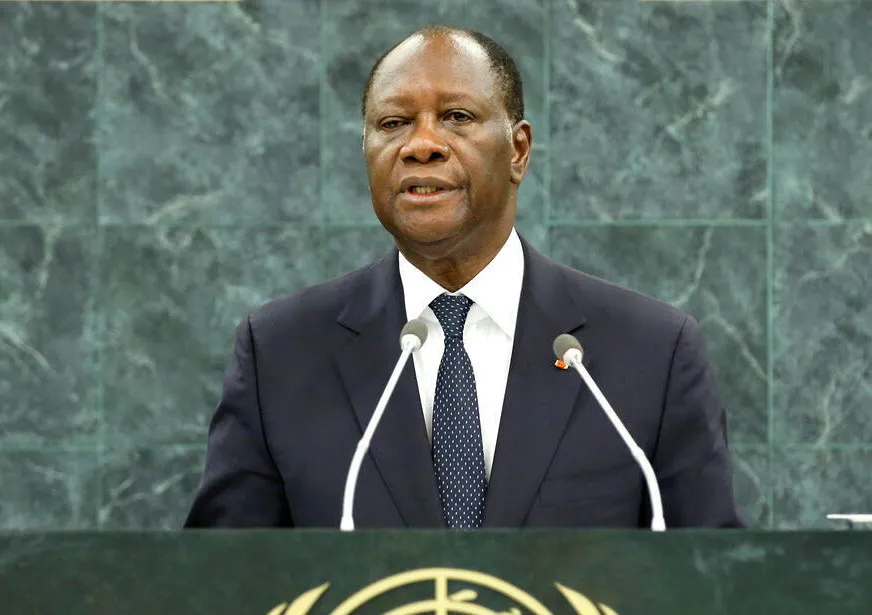
Alassane Ouattara, the president of the Ivory Coast, was sworn in for a fourth term on Monday after a low-turnout election that was boycotted by his two main rivals.
Eleven African leaders and foreign dignitaries reportedly attended the ceremony as the 83-year-old governor, who has led the West African country since 2010, took the oath of office.
Ouattara pledged to uphold the country’s laws in his brief speech. Shortly after taking the oath of office, he proclaimed, “I vow to loyally defend the constitution.”
The inauguration took place in Yamoussoukro, the capital, about six weeks after Ouattara won a landslide 90% of the vote in the October 25 presidential election, despite only 50.1% of voters casting ballots, prompting concerns about legality and public enthusiasm.
The exclusion of Ouattara’s two most notable opponents, former president Laurent Gbagbo and former head of Credit Suisse Tidjane Thiam, has been cited by critics as a significant weakness in the election process.
Thiam was allegedly excluded due to nationality concerns, while Gbagbo was disqualified because of a prior criminal record. At the inauguration, neither was there.
In a nation where disputed elections have frequently produced upheaval, their absence has increased political tensions.
The ceremony attracted significant international attention in spite of the controversy. Former Nigerian President Mahamadou Issoufou and delegates from eleven African countries were among those present.
Speaker of the National Assembly Yael Braun-Pivet represented France, the nation’s strong friend and former colonial power. Jacob Helberg, the Under Secretary of State for Economic Affairs, was sent by the United States to meet with Ouattara later that day for bilateral negotiations.
According to reports, Ouattara initially took office following a contentious election in 2010 that resulted in civil unrest and hundreds of fatalities. Since then, he has kept a solid hold on the president, gaining reelection in 2015 and prolonging his tenure through judicial decisions and constitutional modifications.
Opposition leaders and civil society organizations have criticized his most recent term, the fourth, claiming it compromises regional democratic norms.
The inauguration takes place amid concerns about military takeovers, electoral manipulation, and democratic regression in a number of West African countries.
Observers claim that Ouattara’s reelection highlights the weakness of the region’s democratic institutions, particularly in light of the controversial circumstances.