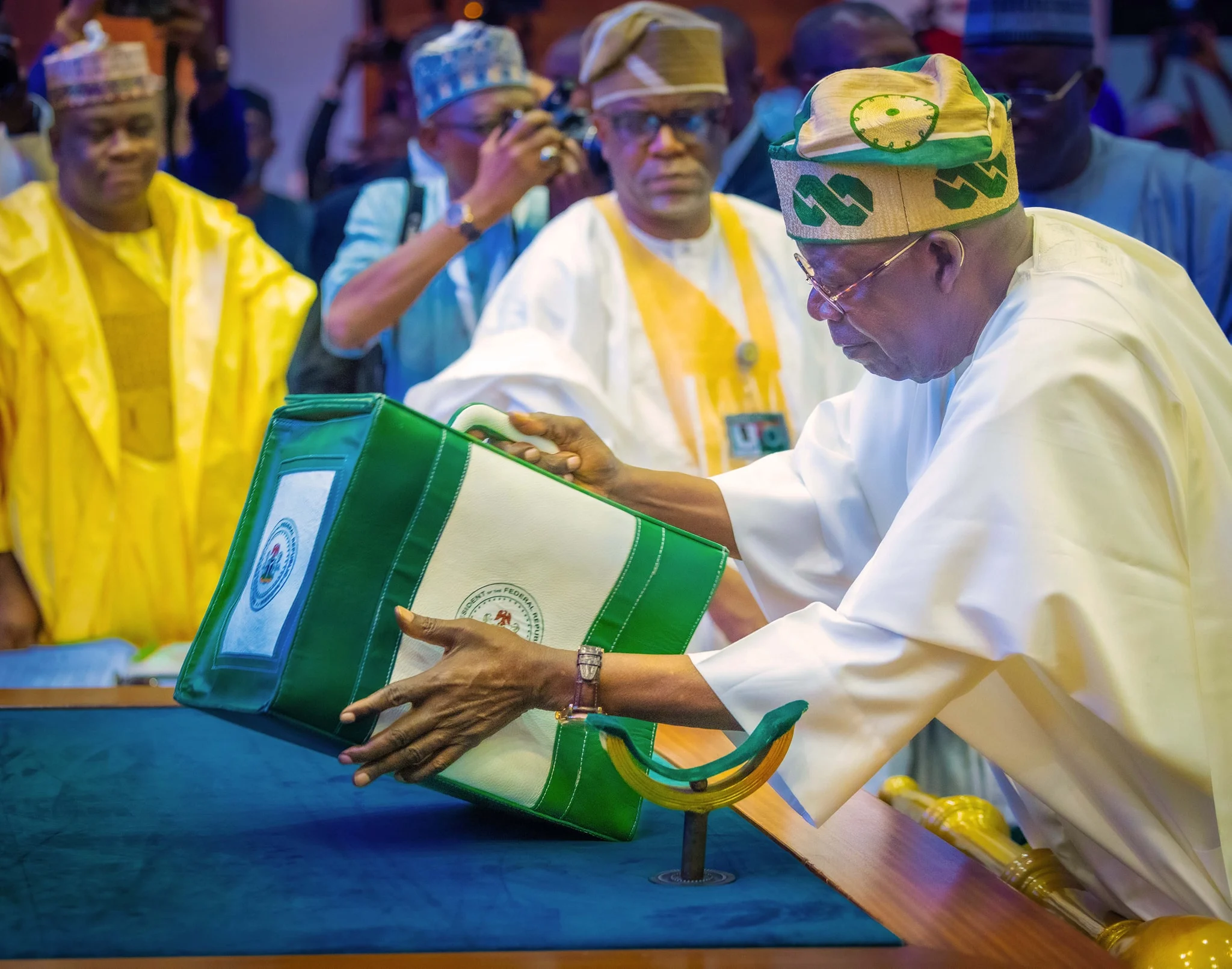
The 2026 Appropriations Bill, which President Bola Tinubu submitted to a joint session of the National Assembly on Thursday, calls for a total budget of N58.46 trillion, of which N15.25 trillion is expected for non-debt recurrent expenditures.
During his speech, the President established N26.08 trillion for capital expenditures and US$64.85 per barrel as the benchmark for crude oil prices for the fiscal year.
The President’s address and a summary of the 2026 budget are available here.
Techniques
Respected Senate President,
Honorable Members of the House of Representatives and Honorable Speaker,
Respected Senators and Honorable National Assembly Members,
Friends from Nigeria,
1. I am here to bring the Federal Republic of Nigeria’s 2026 Appropriations Bill before this Joint Session of the National Assembly in accordance with my constitutional obligation.
2. In the process of reforming and transforming our country, this is a turning point. We have made a conscious decision over the past two and a half years to address long-standing structural flaws, stabilize our economy, restore trust, and create a solid basis for a more resilient, inclusive, and dynamic Nigeria.
3. These changes have not been easy, but they were necessary. Budget execution has been put to the test, established procedures have been upset, and families and businesses have experienced strain. I openly accept these challenges and reassure Nigerians that their sacrifices are not in vain. Reform is the most certain way to achieve shared wealth and long-term stability, but it is rarely easy.
4. Today, we provide a budget that unifies our progress, fortifies our resiliency, and transforms recovery into higher living standards for every Nigerian household.
The budget’s theme for 2026
5. The topic of the budget for 2026 is “Budget of Consolidation, Renewed Resilience and Shared Prosperity.” It demonstrates our commitment to securing macroeconomic stability, enhancing competitiveness, and guaranteeing that growth results in respectable employment, rising wages, and an improved standard of living throughout our Federation.
Economic realities: indicators of stabilization and the goal of the following action
6. In light of the strengthening global picture, Mr. Chairman of this Joint Sitting, the 2026 Budget was created. However, Nigeria continues to be our first priority: creating a robust economy that benefits our citizens.
7. The fact that our reform initiatives are already producing quantifiable effects gives me hope:
Compared to the 3.86% growth in Q3 2024, our GDP expanded by 3.98% in Q3 2025.
Headline inflation dropped from 24.23% in March 2025 to 14.45% in November 2025, marking eight consecutive months of moderation in inflation. We anticipate that the disinflationary trend will continue due to stabilizing food and energy prices, tighter monetary conditions, and better supply responses. This means that, absent significant supply shocks, inflation will continue to drop over the 2026 timeframe.
Oil output has increased thanks to sector reforms, increased security, and technological deployment.
Improved tax management, not high taxes, has greatly increased non-oil revenues.
Capital inflows, fresh project finance, and increased private sector involvement are all indicators of the recovery of investor confidence.
As of November 14, 2025, our external reserves had increased to a seven-year high of over US$47 billion, offering more than ten months’ worth of import coverage and a more robust buffer against shocks.
8. These results are deliberate. They are a reflection of thoughtful yet challenging policy choices. Now is the time to build on these successes so that stability leads to prosperity and prosperity leads to shared wealth.
LESSONS, ACCOUNTABILITY, AND EXECUTION OF THE 2025 BUDGET PERFORMANCE
9. Distinguished Members, the implementation of our 2025 budget had to deal with the challenges of transition and conflicting demands for execution. As of Q3 2025, our records showed:
61% of our goal, or N18.6 trillion in revenue; and
60% of our goal, or N24.66 trillion, was spent.
10. As of June 2025, N2.23 trillion has been released for the execution of 2024 capital projects after the 2024 capital budget execution was extended to December 2025.
11. The government fulfilled its primary responsibilities despite ongoing financial difficulties. However, as of Q3, only N3.10 trillion, or around 17.7% of the 2025 capital budget, has been disclosed, indicating the focus on finishing priority 2024 capital projects during the transition period.
12. To be clear, 2026 will be a year of increased budget execution discipline. To ensure that the 2026 Budget is implemented strictly in accordance with the appropriated details and timelines, I have given directives to the Honourable Minister of Finance and Coordinating Minister of the Economy, the Honourable Minister of Budget and Economic Planning, the Accountant-General of the Federation, and the Director-General of the Budget Office of the Federation.
13. With the new National Tax Acts and the ongoing changes in the oil and gas industry, we anticipate better revenue performance. These reforms are intended to promote openness, efficiency, fairness, and long-term value in our fiscal architecture in addition to increasing revenue.
14. I’ll also be clear about government-owned businesses. All GOE heads are hereby instructed to meet the income targets that have been given to them. We will implement end-to-end digitization of revenue mobilization to support this, including standardized e-collections, interoperable payment rails, automated reconciliation, data-driven risk profiling, and real-time performance dashboards. This will ensure that leakages are sealed, compliance is verifiable, and remittances are timely. Institutional scorecards and performance reviews will be built around these goals. Leakages, inefficiencies, and poor performance in vital agencies are no longer acceptable to Nigeria. Each institution needs to contribute.
The 2026 Budget’s goals and philosophy
15. The 2026 Budget is directed by four distinct goals, Mr. Chairman and fellow Nigerians:
First, stabilize the macroeconomic environment;
2. Enhance the business and investment landscape
Three, lessen poverty and encourage growth that is rich in jobs; and
Four, bolster human capital while safeguarding the weak.
16. To put it succinctly, we will pursue growth that is broad rather than limited, sustainable rather than transient, and manage debt with discipline.
Summary of the 2026 Budget: The Financial Structure
17. Distinguished Members, the Federal Budget for 2026 is based on growth direction, prudence, and realism.
18. These are the major aggregates:
Total revenue of N34.33 trillion is anticipated.
An estimated N58.18 trillion will be spent overall, of which N15.52 trillion will go toward debt repayment.
Recurring (non-debt) spending: N15.25 trillion.
Spending on capital: N26.08 trillion.
4.28% of GDP, or N23.85 trillion, is the budget deficit.
19. These figures represent more than simply accounting lines. They represent the priorities of the country. We are still steadfastly devoted to value-for-money spending, debt transparency, and fiscal sustainability.
20. The 2026–2028 Medium-Term Expenditure Framework and Fiscal Strategy Paper establishes the budget’s criteria. The foundation of our forecasts is:
a prudent benchmark for crude oil at US$64.85 per barrel;
daily production of 1.84 million barrels of crude oil; and
For the fiscal year 2026, the currency rate was ₦1,400 to the USD.
21. We will keep cutting back on waste, tightening regulations, and making sure that every naira borrowed or spent generates quantifiable public benefit, particularly in the areas of infrastructure, human capital, and security.
SECURITY, PEOPLE, AND PRODUCTIVITY AS PRIORITIES AND ALLOCATIONS
22. Nigerians’ practical needs and the Renewed Hope Agenda are reflected in our allocations. Among the important sectoral provisions are:
N5.41 trillion for security and defense
Facilities: N3.56 trillion
Schooling: N3.52 trillion
Medical: N2.48 trillion
23. These priorities are connected. Investments will fail in the absence of security. Productivity will not increase without folks who are healthy and educated. Infrastructure is necessary for businesses and jobs to grow. For this reason, the budget is created as a single, cohesive national revitalization program.
24. Development is still built on security. The Budget for 2026 increases assistance for:
updating the armed forces;
intelligence-driven law enforcement and collaborative efforts;
border protection and technology-assisted monitoring; and
community-based efforts to prevent conflict and promote peace.
25. Since security spending must result in security outcomes, we will invest in security with clear accountability for results. Our first priority will continue to be enhancing the fighting capabilities of our armed forces and other security agencies through manpower increases and the acquisition of state-of-the-art platforms and other gear in order to safeguard our nation. In order to eradicate terrorism, banditry, abduction for ransom, and other violent crimes, we are also pursuing a new era in the criminal justice system. A new national counterterrorism doctrine—a comprehensive redesign based on unified command, intelligence, community stability, and counter-insurgency—is being established by our administration along with a reset of the national security architecture. This new ideology will drastically alter how we deal with terrorism and other violent crimes that have increased public fear and become existential threats to our corporate survival.
Any armed group or non-state actors with guns acting outside of official authority will be considered terrorists going forward under this new architecture. Bandits, militias, armed gangs, armed criminal networks, armed robbers, violent cult organizations, armed collectives headquartered in forests, and foreign-affiliated mercenaries are some examples of these. Terrorists also include organizations or individuals that use violence for sectarian, political, ethnic, or financial purposes. Any group that kidnaps civilians, extorts communities, or occupies or seeks to occupy Nigerian land would be labeled as terrorists. The commonality is that you are a terrorist if you use deadly weapons and act outside the bounds of official authority. Terrorists will also include any person or organization that facilitates the stated groups as financiers, money handlers, harborers, informants, ransom facilitators, and negotiators. Owners of safe houses, arms suppliers, transporters, and political guardians and intermediaries will all be labeled terrorists. Terrorists include politicians, traditional leaders, community leaders, and religious leaders who support and incite acts of violence and terror against Nigerians.
26. The caliber of a country’s citizens is its greatest asset. The budget for 2026 increases spending on social protection, healthcare, education, and skills.
27. In terms of education, we are using the Nigerian Education Loan Fund to increase access to higher education. In collaboration with 229 postsecondary institutions around the country, more than 418,000 students have received assistance.
28. I’m happy to point you that, net of liabilities, healthcare spending accounts for 6% of the whole budget.
29. International partners’ assistance is also greatly appreciated. More than US$500 million in grant financing for focused health treatments throughout Nigeria is now possible because to recent high-level interactions with the US government. We applaud this collaboration and guarantee Nigerians that these resources will be used efficiently and openly.
30. Throughout the country, initiatives under the Renewed Hope Agenda—such as energy and transportation infrastructure, port modernization, agricultural reforms, and strategic investments that unlock private capital—are progressing from concept to reality.
31. We will act decisively to bolster agricultural markets. Security of food is security of the country. Agro-value chains, irrigation and climate-resilient agriculture, storage and processing, and input financing and mechanization are all given top priority in the 2026 budget.
32. These actions will strengthen agro-industrialization, lower post-harvest losses, increase smallholder incomes, and create a more robust, diverse economy.
DISCIPLINE, NATIONAL COMPACT, AND DELIVERY
33. Distinguished Members and fellow Nigerians, we do not announce the best budget. We are the ones who provide it.
34. Consequently, three pragmatic commitments will serve as the foundation for 2026:
Efficiency, transparency, and compliance—particularly from GOEs—as well as better governance of the oil and gas industry will increase revenue mobilization.
Spending more wisely means giving priority to initiatives that citizens can measure, feel, and finish.
Improved accountability: bolstering monitoring, reporting, and procurement discipline so Nigerians can understand what their money is supporting.
35. We shall establish confidence by aligning our statements with outcomes and allocations with results.
RESULTS: A BUDGET THAT IS OURS ALL
36. Remarkable The 2026 budget is a budget of consolidation, renewed resilience, and shared prosperity, not a budget of promises, fellow Nigerians and members of the National Assembly. It addresses new issues, expands on the reforms of the previous 2.5 years, and lays out a clear course for a Nigeria that is safer, more competitive, more equal, and more optimistic.
37. I applaud our people for their perseverance, understanding, and selflessness. My government is still dedicated to making the transition easier and making sure that households and communities throughout the Federation benefit from reform.
38. We will fulfill the entire promise of the Renewed Hope Agenda with the help of the Nigerian people’s tenacity and the Executive and Legislature’s shared goal.
39. As a result, I am delighted to present to this esteemed Joint Session of the National Assembly the Federal Republic of Nigeria’s 2026 Appropriations Bill, which is titled “Budget of Consolidation, Renewed Resilience and Shared Prosperity.”
God bless Nigeria’s Federal Republic.
Join Television Nigerian Whatsapp Now
Join Television Nigerian Facebook Now
Join Television Nigerian Twitter Now
Join Television Nigerian YouTUbe Now